
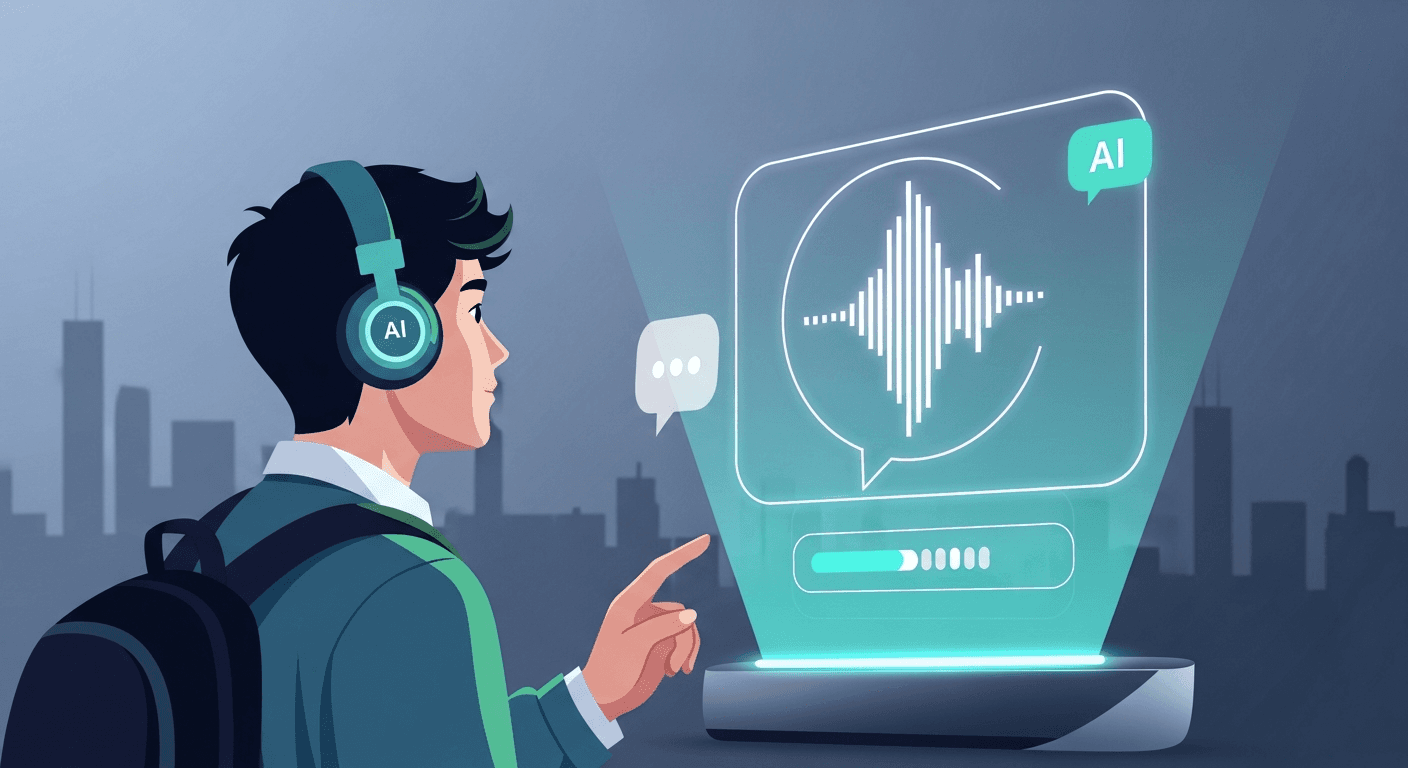
The Vocal Sparring Partner: Polishing HKDSE Speaking Fluency via Real-Time Speech-to-Speech AI Interaction
Let us face the reality of HKDSE English Language Paper 4: staring into your bedroom mirror and arguing with your own reflection is not going to secure you a Level 5**. The group interaction segment is notoriously unpredictable. You might face a dominant candidate who refuses to yield the floor, a nervous peer who responds in single syllables, or a complex topic that leaves your mind completely blank. Effective exam preparation for the speaking paper requires spontaneity, rapid vocabulary retrieval, and the confidence to interject politely. Traditional solo practice simply cannot replicate this high-pressure environment.
For years, students have relied on recording themselves on their phones or waiting for that one 15-minute mock speaking session at school. But the educational technology landscape has shifted dramatically. Enter the era of real-time Speech-to-Speech (S2S) AI. Unlike the clunky, robotic dictation tools of the past, the latest conversational AI models can listen to your tone, understand your hesitations, and respond instantly with human-like rhythm. It is like having an elite debate coach and a native English speaker in your pocket, available 24/7. Today, we are going to explore how transforming your study routine with an AI vocal sparring partner can drastically elevate your HKDSE speaking fluency.
The Bottleneck of Traditional Spoken English Practice
Before diving into the tech, we must understand why so many talented HKDSE students struggle to push past a Level 4 in their speaking exams. The primary culprit is a lack of dynamic conversational mileage. Reading vocabulary lists from your HKDSE Study Notes is a great start, but passive reading does not build the neural pathways required for active, on-the-spot articulation.
Furthermore, classroom practice is often hampered by the "affective filter"—a psychological term for the anxiety and fear of judgment that prevents students from taking linguistic risks. When you are terrified of mispronouncing a word in front of your classmates, you naturally default to safe, basic vocabulary. You lose the opportunity to experiment with advanced idioms or complex sentence structures. This is exactly where modern educational tools step in to bridge the gap.
What is Real-Time Speech-to-Speech AI Interaction?
Recent breakthroughs in artificial intelligence have moved beyond simple text-based chatbots. Real-time Speech-to-Speech AI allows you to speak into your device and receive an immediate, spoken response without the jarring lag that used to plague older translation apps. These models are trained to pick up on prosody—the rhythm, stress, and intonation of speech.
This means the AI can detect when you end a sentence with a questioning tone, when you are hesitating, or when you are emphatically making a point. It completely redefines personalized learning, shifting the focus from static text memorization to fluid, organic conversation. For an HKDSE candidate, this technology simulates the unpredictable nature of a real group discussion.
3 Ways an AI Sparring Partner Supercharges Your Fluency
1. Mastering the Art of the "Polite Interruption"
In Paper 4, markers assess your communication strategies, including how well you manage the flow of conversation. You can instruct a voice-enabled AI to deliberately play the role of a "dominant candidate." By asking the AI to speak at length about a specific topic, you can practice your timing and phrasing for interjections. "That is a valid point, but have we considered..." or "I see where you are coming from, however..." Practicing these transitions with an AI removes the awkwardness and helps you develop instinctual timing.
2. Instantaneous Feedback on Pronunciation and Stress
A brilliant argument falls flat if the examiner cannot understand your pronunciation. S2S AI acts as an objective listener. If the AI repeatedly misinterprets a specific word you are saying, it is a clear indicator that your pronunciation or syllable stress needs work. This immediate feedback loop is a hallmark of effective AI-powered learning. You can instantly course-correct, repeating the phrase until the AI accurately registers your intended meaning.
3. The "No-Judgment Zone" for Vocabulary Expansion
Have you ever learned a fantastic new phrase like "a paradigm shift" or "a double-edged sword," but felt too embarrassed to use it in class just in case you used it wrong? An AI sparring partner does not judge. It creates a safe psychological space where you can experiment with high-level vocabulary. If you use an idiom incorrectly, the AI will naturally respond in a way that highlights the misstep, or you can explicitly ask it to correct your phrasing at the end of the session.
Actionable Guide: Setting Up Your AI Mock Exam
To get the most out of your study platform or AI voice tool, you need to provide specific, context-rich instructions. Here is a step-by-step approach to running your own HKDSE Paper 4 simulation:
Step 1: Set the Scenario
Begin your voice session by verbally defining the parameters. You might say: "Act as a fellow HKDSE candidate in a 4-person group discussion. We are discussing whether artificial intelligence should be banned in secondary schools. Keep your responses under 30 seconds, occasionally disagree with my points, and ask me follow-up questions."
Step 2: Engage in the Sparring Session
Put away your notes and engage naturally. Focus on your eye contact (even if you are just looking at your phone screen or a wall), your posture, and your voice projection. Treat the AI's responses exactly as you would a peer's. If the AI brings up a point about cheating, counter it by discussing the benefits of personalized tutoring.
Step 3: Request the Post-Match Analysis
Once the 8-minute discussion timer goes off, end the roleplay. Ask the AI: "Can you evaluate my performance based on vocabulary usage, grammatical accuracy, and idea development? What are three specific phrases I could have used to make my arguments sound more sophisticated?" This turns a simple chat into a highly targeted study session.
The Thinka Advantage: Elevating Your Study Efficiency
While general voice AI tools are fantastic, navigating the vast sea of prompts and setups can sometimes be overwhelming. This is where dedicated platforms shine. By integrating intelligent technologies that understand local curriculum standards, you can streamline your revision process. If you want to experience how tailored educational technology can improve your study efficiency across all subjects, you can Start Practicing in AI-Powered Practice Platform today.
Platforms like Thinka are designed to align with the specific academic hurdles you face in Hong Kong. Whether you are reviewing core concepts or looking to push your analytical boundaries, leveraging an ecosystem built around adaptive learning ensures that every minute of your study time is optimized for maximum impact. By tracking your progress and identifying your unique weak points, the platform delivers the exact resources you need, precisely when you need them.
Pro Tip: Start Building the Habit Early
Fluency is not built in a week. It requires consistent, daily practice. If you are reading this as a younger student, the best time to start practicing spoken English is right now. Building conversational confidence early on prevents the panicked cramming that often happens in S6. You can explore our Junior Secondary School (S1 - S3) Study Notes to start gathering the vocabulary and themes you will eventually need to debate in your senior years.
Overcoming the "Robotic" Trap
A word of caution: while an AI sparring partner is an incredible asset, you must be careful not to absorb the sometimes overly formal or "robotic" tone that AI models default to. HKDSE examiners are looking for genuine, natural communication, not an audiobook narrator.
Use the AI to build your reflex speed, expand your vocabulary, and practice your interjections, but always inject your own personality into the delivery. Use natural fillers appropriately, vary your pacing, and do not be afraid to show genuine enthusiasm for the topic at hand. The goal of using technology is to enhance your authentic human voice, not replace it.
Final Thoughts for HKDSE Candidates
Securing a top grade in English Paper 4 is less about having a flawless accent and much more about demonstrating communicative competence, quick thinking, and collaborative skills. Real-time Speech-to-Speech AI offers an unprecedented opportunity to practice these exact skills in a low-pressure, high-yield environment. It is the ultimate vocal sparring partner—tireless, responsive, and uniquely tailored to your learning pace.
Stop leaving your speaking scores up to chance or the unpredictability of your mock exam group. Embrace the latest educational tech trends, build your conversational stamina, and walk into that examination room knowing you have already debated every possible angle a hundred times before. To discover more innovative ways to revolutionize your study habits and conquer your exams, head over to the thinka Home Page and unlock your full academic potential today!