
Beyond Text Prompts: Harnessing Multimodal AI to Decode Complex HKDSE Science Diagrams and Graphs
Picture this: It’s 11:00 PM. You are deep into a Physics revision session, grinding through past papers from 2018. You turn the page and hit a roadblock—a complex diagram of a transformer circuit or a confusing free-body diagram involving friction on an inclined plane. You try to type the question into a standard chatbot, but describing the angles, the arrows, and the labels takes ten minutes, and the AI still misunderstands the setup. Frustrating, right?
For years, AI-powered learning was limited to text. You had to type to get an answer. But for HKDSE Science students—taking Biology, Chemistry, Physics, or Combined Science—text isn't enough. Science is visual. It’s about interpreting electron micrographs, analyzing rate-of-reaction graphs, and decoding vector diagrams.
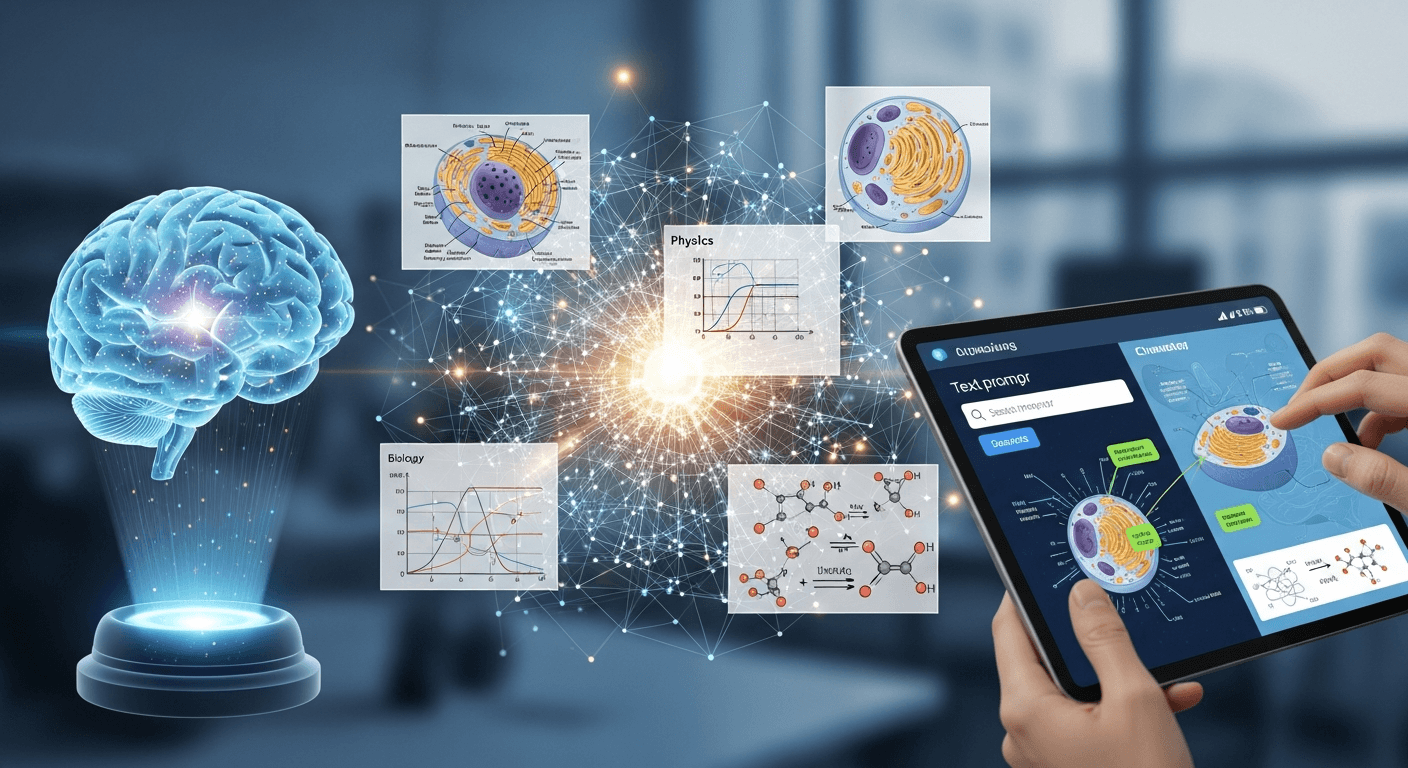
Welcome to the era of Multimodal AI. This technology allows you to upload images alongside your questions, enabling the AI to "see" what you are seeing. Here is how you can move beyond simple text prompts and harness visual AI to decode the most complex diagrams in the HKDSE curriculum.
The Visual Hurdle: Why Text Prompts Fail in Science
In the HKDSE Science curriculum, a significant percentage of marks are tied to Data-Based Questions (DBQs) and diagrammatic interpretation. Whether it is identifying the stage of mitosis in Biology or calculating the slope of a velocity-time graph in Physics, the visual context is everything.
Traditional text-based AI fails here because:
1. Spatial relationships are hard to describe: Trying to explain exactly where a mitochondrion is located relative to the nucleus in a specific diagram is tedious.
2. Graph trends are nuanced: Describing a curve that "goes up, then flattens, then drops slightly" is vague. The AI needs to see the axes and the scale.
3. Circuit topology matters: In Physics, whether a resistor is in series or parallel changes the entire calculation.
What is Multimodal AI?
Multimodal AI refers to artificial intelligence models that can process and understand multiple types of input simultaneously—specifically text and images. When you use a modern study platform equipped with these capabilities, the AI scans the pixels in your uploaded image, identifies text labels (OCR), recognizes shapes (cells, beakers, pulleys), and synthesizes this with your text question to provide a context-aware answer.
Strategy 1: Biology — The "Hidden Structure" Identification
The Challenge: HKDSE Biology Paper 1 often features photomicrographs or diagrams of physiological processes (like the Krebs cycle or translation in protein synthesis). The question might ask you to deduce a function based on visible structural adaptations.
The AI Solution: Instead of asking "What does a chloroplast do?", take a photo of the specific diagram in your past paper where the chloroplast has an unusual shape or arrangement.
How to Prompt:
"I am uploading a diagram of a leaf cross-section from a DSE practice paper. Based on the density of the organelles labeled 'X' in the upper layer, explain how this adaptation supports the process of photosynthesis in this specific plant environment."
Why this works: The AI analyzes the visual density and position of the organelles in your image, linking the visual evidence to the theoretical concept of high light intensity adaptation.
Strategy 2: Physics — Verifying Force Diagrams and Mechanics
The Challenge: Mechanics questions often involve objects on slopes with multiple forces: gravity, normal force, friction, and applied force. Getting the vector components wrong leads to losing all calculation marks.
The AI Solution: Use Multimodal AI to check your free-body diagrams before you start calculating. Draw your diagram, snap a picture, and upload it.
How to Prompt:
"I have drawn a free-body diagram for a block sliding down a rough incline. Please analyze my drawing. Have I correctly oriented the friction vector relative to the motion? Also, verify if my component of weight parallel to the slope, labeled as \( mg \sin\theta \), is correct for this setup."
This acts as an instant tutor, catching conceptual errors before you waste time on the math. It ensures your foundation is solid before you apply formulas like:
$$ F_{net} = ma $$
Strategy 3: Chemistry — decoding Trends in Reaction Graphs
The Challenge: Chemistry requires you to interpret graphs showing changes in concentration, pH, or temperature over time. A common pitfall is misinterpreting why a slope changes at a specific timestamp.
The AI Solution: Upload the graph. The AI can read the axes and the curve shape to explain the chemical kinetics happening at specific points.
How to Prompt:
"Look at this reaction rate graph. At time \( t = 2 \text{ min} \), the curve flattens out. Based on the axes, does this indicate the reaction has stopped or reached equilibrium? Explain the difference visually."
Quick Fact: Recent updates in AI vision models allow them to read logarithmic scales, making them incredibly useful for pH curves and acid-base titration questions.
The Thinka Difference: Context-Aware Learning
While general AI tools are powerful, they often lack the specific context of the Hong Kong curriculum. They might explain a concept using US Common Core standards or university-level physics that isn't relevant to your exam.
This is where personalized learning on a dedicated platform shines. Start Practicing in AI-Powered Practice Platform like Thinka means utilizing a system designed with the HKDSE framework in mind. Thinka’s architecture is built to understand not just the science, but how the Hong Kong Examinations and Assessment Authority (HKEAA) phrases questions and awards marks.
By integrating visual analysis with a database of HKDSE-style logic, specialized educational technology helps you stay within the scope of the syllabus, preventing you from learning irrelevant information.
Pro Tips for "Visual Prompting"
To get the best results from exam preparation using Multimodal AI, follow these best practices:
1. Crop for Clarity: Don't upload the entire page. Crop the image to focus specifically on the diagram or graph in question. Extraneous text can confuse the AI.
2. Lighting Matters: Ensure there is no glare on glossy textbook pages. High contrast helps the AI read labels (like \( V_{in} \) or \( V_{out} \)) accurately.
3. Direct Attention: Use your phone’s markup tool to circle the specific part of the graph you are confused about before uploading. "Explain the anomaly in the red circle" is a powerful prompt.
Bridging the Gap for Junior Students
This technology isn't just for Form 6 students. Building visual literacy starts early. Junior secondary students struggling with basic Integrated Science diagrams—like the water cycle or simple circuits—can use these tools to build a strong foundation.
If you are looking to strengthen your basics, check out our resources for Junior Secondary School (S1 - S3) Study Notes. Establishing these skills now will make the transition to the DSE curriculum much smoother.
Current Trends: The Rise of "Interactive" Papers
Educational news outlets are reporting a shift toward "interactive assessments" globally. While the HKDSE is still paper-based, university entrance exams and internal school assessments are increasingly using digital formats where students must interact with diagrams. Mastering the skill of interpreting visuals with AI assistance prepares you not just for the DSE, but for modern university courses where digital literacy is mandatory.
Conclusion: Study Smarter, Not Harder
The HKDSE is a marathon, and efficiency is your most valuable resource. You no longer need to spend hours searching for a teacher to explain a single graph. By harnessing Multimodal AI, you turn every visual roadblock into a learning opportunity.
Remember, the goal isn't to have the AI do the work for you—it is to use the AI to understand the mechanism behind the diagram. Once you decode the visual logic, you own that knowledge for the exam.
Ready to upgrade your revision strategy? Dive into comprehensive materials and tools designed for your success. Visit our HKDSE Study Notes to supplement your AI practice, or explore our thinka Home Page to see how we are revolutionizing education in Hong Kong.
Don't just look at the diagram—understand it with Thinka.