
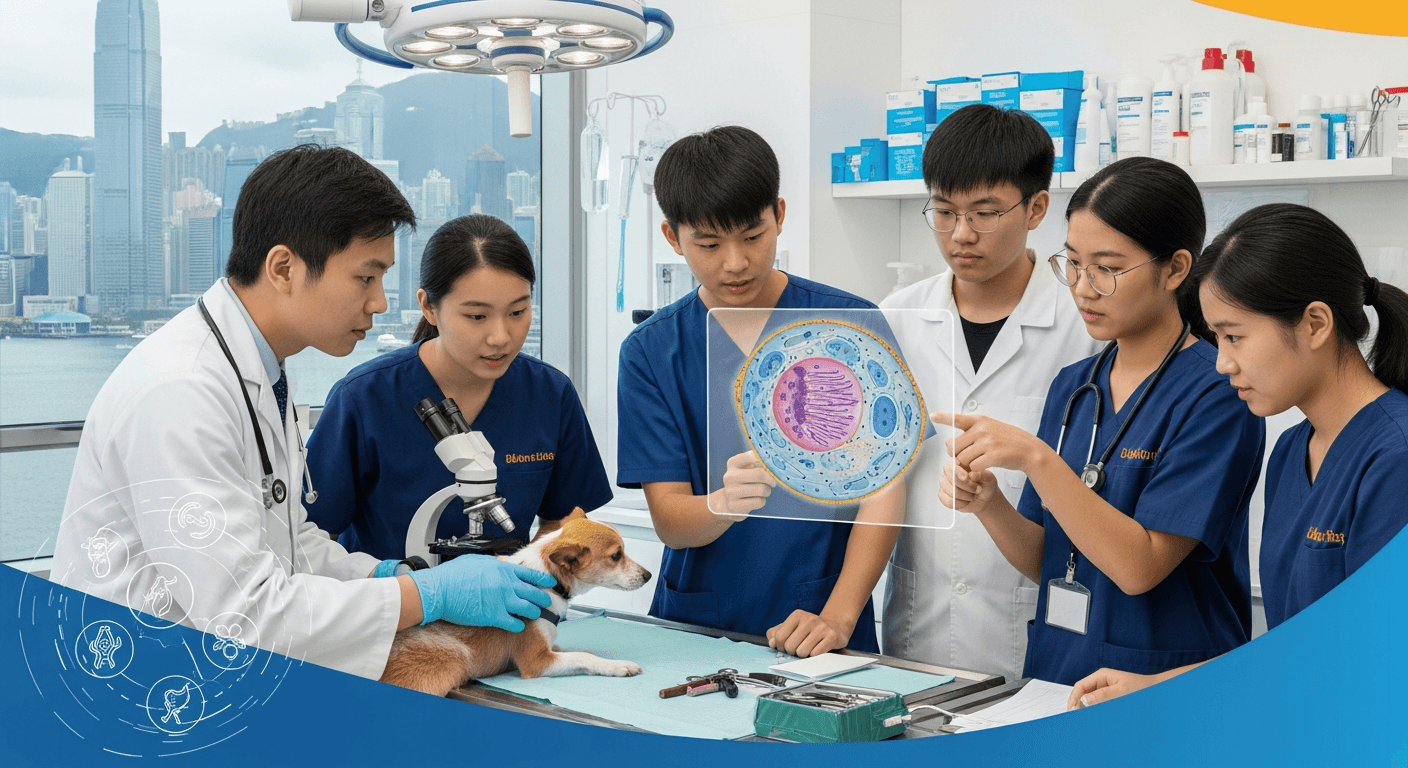
The Veterinary Breakthrough: Leveraging DSE Biology for Clinical Roles in Hong Kong’s Pet Economy
Walk through the streets of Causeway Bay or the promenades of West Kowloon on a weekend, and you’ll notice a shift in demographics. It isn't just about families with children anymore; it’s about families with "fur babies." Hong Kong is experiencing a massive boom in the pet economy, with the number of pets increasingly rivaling the number of children in many households.
For HKDSE students, this cultural shift represents more than just cute Instagram content—it signals a lucrative, high-demand, and scientifically rigorous career pathway: Veterinary Medicine. Gone are the days when becoming a doctor or a lawyer were the only "prestige" paths. Today, the competition for the Bachelor of Veterinary Medicine (BVM) program at City University of Hong Kong is fierce, often requiring scores comparable to human medicine.
But how does your current HKDSE Biology textbook translate to a clinical role? How do you bridge the gap between memorizing the Krebs cycle and saving a Golden Retriever? In this guide, we will dissect the connection between the DSE syllabus and the veterinary profession, and explore how AI-powered learning can help you secure your spot in this elite field.
1. The "Pet Economy" Context: Why This Career Path is Future-Proof
Before diving into the academics, it is crucial to understand the market forces. The "Pet Economy" in Hong Kong has proven to be recession-proof. As the birth rate declines, emotional investment in pets increases. This has led to a surge in demand for:
- General Practitioners: Routine care, vaccinations, and check-ups.
- Specialists: Veterinary oncologists, cardiologists, and neurologists.
- Veterinary Nurses & Technicians: The backbone of clinical operations.
Quick Fact: The Veterinary Surgeons Board of Hong Kong reports a consistent need for qualified professionals, and with CityU being the only local university offering an accredited BVM, the supply is tight while demand skyrockets. This equals high job security and strong earning potential for future graduates.
2. Decoding the JUPAS Entry: It’s All About the Weighted Score
If you are eyeing the CityU BVM (JUPAS Code: JS1801), you need to treat your DSE elective selection and performance strategically. This is not a degree where you can "scrape by" in Science.
The Golden Trio: Biology, Chemistry, and English.
While the exact admission formulas change, Chemistry and Biology usually carry heavy weighting. To visualize the importance of excelling in your electives, consider a hypothetical admission score calculation where electives are weighted at 1.5x:
$$ \text{Admission Score} = ( \text{Eng} + \text{Math} + \text{Bio} \times 1.5 + \text{Chem} \times 1.5 + \text{Best } X ) $$
If you score a Level 4 in Biology versus a Level 5*, the impact on your weighted score is massive due to that multiplier. This is why exam preparation for these specific subjects must be flawless.
Pro Tip: Mathematics is often the silent killer for Vet hopefuls. You need strong logic and statistical understanding for epidemiology and dosing calculations later in your career.
3. Bridging the Gap: From DSE Biology to Clinical Diagnosis
Many students find DSE Biology dry because it feels abstract. However, if you view the syllabus through the lens of a veterinarian, the content comes alive. Here is how to leverage your current study topics for your future career (and your interview):
A. Homeostasis: The Kidney Connection
DSE Topic: Regulation of water content in blood (osmoregulation) and the role of the kidney.
Clinical Application: Chronic Kidney Disease (CKD) is one of the most common killers of senior cats. When you study the structure of the nephron and ultrafiltration, you are studying the exact mechanism that fails in feline patients. Understanding how ADH (antidiuretic hormone) works isn't just for Paper 1; it’s the basis for understanding why a sick cat drinks excessive water.
B. Microorganisms and Immunity: The Vaccine Debate
DSE Topic: Body defense mechanisms, antigens, antibodies, and vaccination.
Clinical Application: Every year, puppies in Hong Kong die from Parvovirus. Understanding primary vs. secondary immune response (memory cells) explains why veterinarians insist on a strict booster schedule for puppies. When you analyze graphs of antibody concentration in DSE past papers, you are practicing the logic needed to explain immunization protocols to pet owners.
C. Genetics: The Ethics of Breeding
DSE Topic: Inheritance, dominant/recessive alleles, and variation.
Clinical Application: Purebred dogs often suffer from genetic disorders (e.g., hip dysplasia in German Shepherds or breathing issues in Pugs). A strong grasp of pedigree analysis allows a vet to understand the hereditary nature of these conditions. This is often a hot topic in admission interviews—combining scientific knowledge with ethical reasoning.
Need to brush up on these concepts? Check out our HKDSE Study Notes to solidify your foundation in Biology.
4. The AI Advantage: Diagnosing Your Study Weaknesses
The volume of information required for Biology and Chemistry is overwhelming. This is where modern technology steps in. Just as veterinarians use MRI and CT scans to look inside a patient, you should be using AI-powered learning tools to look inside your own study habits.
Traditional revision involves reading notes passively. This is inefficient. Personalized learning platforms like Thinka use algorithms to identify your "knowledge blind spots."
How AI Mimics Clinical Thinking:
- Triage (Assessment): You might think you are bad at "Genetics," but AI analysis might reveal you are actually fine with the concepts but struggle with the specific keywords required for the marking scheme.
- Treatment (Adaptive Practice): Instead of doing random questions, AI serves you questions that target that specific weakness, optimizing your study efficiency.
- Prognosis (Prediction): AI tracks your trajectory, giving you a realistic look at whether you are on track for that Level 5** or if you need to intervene.
To experience how adaptive technology can streamline your revision, you can Start Practicing in AI-Powered Practice Platform today. It helps you stop wasting time on what you already know and focus on where you can gain marks.
5. Beyond Grades: Developing the "Vet" Mindset
Securing a role in the veterinary field requires more than just high academic scores; it demands a specific psychological profile. Admissions officers are looking for resilience and communication skills.
The "One Health" Concept
A trending topic in both biology and veterinary science is "One Health"—the idea that human health, animal health, and environmental health are interconnected. (Think about Zoonotic diseases like Avian Flu or COVID-19).
Actionable Advice: When writing your JUPAS OEA or preparing for interviews, don't just say you "love animals." Discuss how your understanding of DSE Biology topics (like ecology and public health) contributes to the bigger picture of One Health.
6. Strategic Advice for Junior Students
If you are currently in S1 to S3, you have a massive advantage: Time. You don't need to start memorizing DSE notes yet, but you should start building the scientific vocabulary and inquiry skills necessary for the senior curriculum.
- Focus on Science foundations: Don't ignore Integrated Science. The physics of levers (bones/muscles) and basic chemistry (medication) start here.
- Read widely: Read veterinary journals or reputable science news, not just textbooks.
For younger students looking to get ahead, our Junior Secondary School (S1 - S3) Study Notes provide excellent preparation for the rigors of the DSE curriculum.
Conclusion: Your White Coat Awaits
The path to becoming a veterinarian in Hong Kong is undeniably steep. It requires mastering complex biological systems, achieving elite exam scores, and demonstrating profound empathy. However, the reward is a career at the forefront of medical science and animal welfare in a city that values pets more than ever.
Don't let the sheer volume of the DSE syllabus intimidate you. By leveraging AI-powered practice platforms like Thinka, you can transform your revision from a chaotic struggle into a surgical strike on high grades. Treat your exam preparation with the same precision a surgeon treats a patient: diagnose your weaknesses, apply the right treatment (study method), and monitor your recovery (progress).
The veterinary breakthrough starts with your biology textbook. Are you ready to make the connection?
Ready to optimize your biology revision? Visit the thinka Home Page to learn more about how our AI solutions can help you achieve your DSE goals.