
Unlocking the Magic of Words: Why Primary School Parents Should Care About Phonics
Watching your primary school child sound out their first words is a magical milestone, but let us be entirely honest—it can also be a significant source of stress. Whether you are helping them with their nightly reading homework or starting to think about early exam preparation, the pressure to build strong literacy skills is very real. You want your child to not only read fluently but to actually enjoy the process.
If you have been keeping up with recent educational news, you might have heard a buzzword sweeping through primary schools globally: the Science of Reading. Educational ministries and schools are rapidly shifting away from older methods—like asking kids to guess a word based on the pictures—and are moving toward structured, explicit phonics. But how do you translate these rigorous academic standards into something a six- or seven-year-old actually wants to do after a long day at school?
The answer lies in combining evidence-based literacy strategies with the universal language of childhood: play. By using phonics-based play, you can bridge the gap between academic requirements and joyful discovery, setting a solid foundation for their entire educational journey.
The "Science of Reading": A Paradigm Shift in Primary Education
To support your child effectively, it is helpful to understand what the Science of Reading actually means. It is not just a passing trend; it is a comprehensive body of research from cognitive scientists, developmental psychologists, and neuroscience experts. This research maps out exactly how the human brain learns to read.
Quick Fact: Unlike spoken language, which human brains are naturally wired to pick up through exposure, reading is an artificial invention. Our brains literally have to rewire themselves to connect visual symbols (letters) with spoken sounds (phonemes).
For decades, many primary schools relied on "balanced literacy," which often encouraged children to rely on context clues. However, recent educational updates and sweeping curriculum reforms have proven that structured literacy—specifically systematic phonics—is the most reliable way to teach children to decode words. When children understand that the letter "c" makes a /k/ sound, they are not memorizing a single word; they are unlocking a code that allows them to read thousands of words they have never seen before.
Why Phonics-Based Play is Your Secret Weapon
You might be wondering: if phonics is so scientific and structured, does it mean my child has to sit at a desk completing endless worksheets? Absolutely not. In fact, for young learners, forced rote memorization can increase anxiety, raising what educators call the "affective filter." When a child is stressed about making a mistake, their brain literally blocks the absorption of new information.
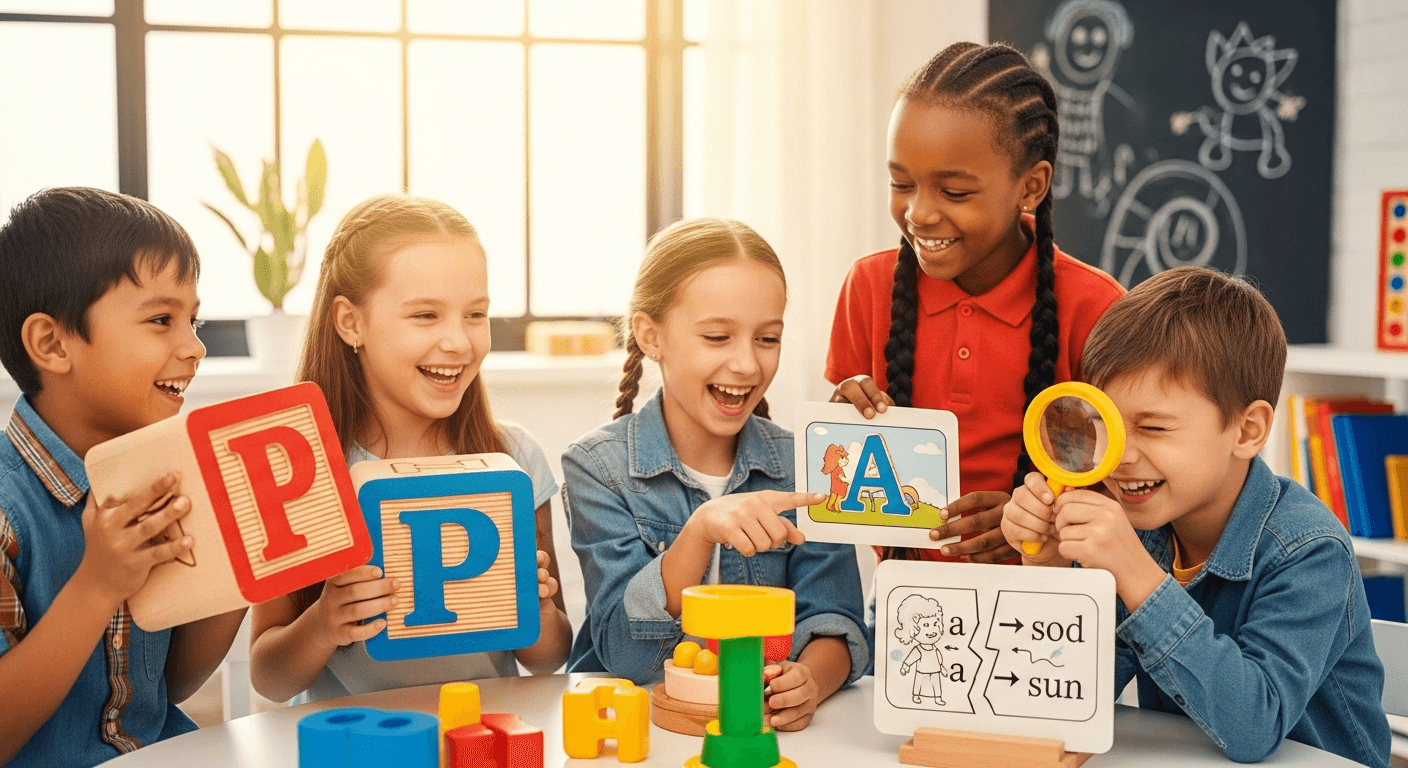
This is where phonics-based play comes in. Play lowers the affective filter. It transforms a daunting task—learning the rules of the English language—into an engaging puzzle. When children are playing, they are experimenting, taking risks, and building neural pathways without even realizing they are "studying."
Step-by-Step Phonics Games to Try at Home
You do not need an education degree or expensive materials to bring the Science of Reading into your living room. Here are practical, actionable games you can start playing today.
1. The "Sound Scavenger Hunt" (Focus on Phonemic Awareness)
Instead of asking your child to find something that starts with the letter "B," ask them to find something that starts with the /b/ sound. Phonemic awareness is the ability to hear and manipulate individual sounds, and it is the most critical precursor to reading. Give them a basket and set a timer. Say, "Find three things in the living room that start with the /m/ sound!" (They might find a mat, a mug, or a marker). This trains their ears to isolate sounds, a vital skill for early spelling tests.
2. "Robot Talk" (Focus on Blending and Segmenting)
Blending (pushing sounds together to make a word) and segmenting (pulling a word apart into sounds) are essential for primary school literacy. Make it a game by adopting a "Robot Voice." Give your child everyday instructions by segmenting the last word. For example, "Please put on your c-oa-t." or "Time for b-e-d." Your child has to blend the sounds together to figure out what you are saying. Once they get the hang of it, let them be the robot and give you instructions.
3. Sticky Note Word Ladders (Focus on Phonics Decoding)
Write individual letters or common sounds (like "sh", "ch", "th") on sticky notes. Start by placing three notes on the table to make a simple word, like C-A-T. Have your child sound it out. Then, tell them you are going to perform a magic trick. Swap the "C" for an "M" to make M-A-T. Then swap the "T" for an "P" to make M-A-P. This visual, tactile play helps children understand how manipulating a single phoneme changes the entire word.
Pro Tip: Keep these sessions short. Ten minutes of highly engaged, playful phonics practice is far more effective than an hour of frustrating, tear-filled reading struggles.
Transitioning from Playroom to the Classroom: Navigating Primary Exams
As your child moves higher up in primary school, the focus naturally begins to shift toward formal assessments. Suddenly, the playful decoding of simple words needs to translate into reading full comprehension passages and tackling dictation exams.
A strong foundation in phonics directly impacts exam preparation. When a child can decode fluently, they do not have to waste precious cognitive energy figuring out what a word says. Instead, they can use that brainpower to understand the meaning of the text. Students who struggle with reading comprehension during primary exams are often actually struggling with basic decoding. By solidifying their phonics skills early through play, you are giving them the tools to confidently tackle complex exam papers later on.
Supercharging Literacy with AI-Powered Learning
While parent-led play is incredibly powerful for introducing concepts, there comes a point where children need structured, consistent practice to truly master their literacy skills. As parents juggle work, household duties, and their children's extracurriculars, it can be difficult to constantly invent new educational games or pinpoint exactly which phonics rules your child is struggling with.
This is where modern educational technology steps in to support both you and your child. Integrating an AI-powered learning system into your child's routine can take the guesswork out of their academic development. Unlike generic worksheets that treat every student the same, modern technology offers personalized learning experiences that adapt in real-time.
Imagine a smart study platform that notices your child is consistently struggling with the "ea" vowel team (as in read or bread). Instead of pushing them forward into harder material and causing frustration, an intelligent system will gently adjust, providing targeted practice and interactive exercises focused exactly on the gaps in their knowledge. This level of adaptability ensures that learning remains at the perfect level of difficulty—challenging enough to promote growth, but accessible enough to keep the child motivated.
Using a platform like Thinka empowers your child to practice independently in a supportive, gamified environment. By exploring the thinka Home Page, parents can discover how adaptive technology mirrors the best practices of the Science of Reading. It transforms screen time into highly productive, stress-free study time, ensuring that the foundational skills built during play are reinforced and expanded upon.
If you are looking to streamline your child's revision and want to see how adaptive technology can elevate their literacy journey, you can easily Start Practicing in AI-Powered Practice Platform. It is a fantastic way to bridge the gap between early learning and structured academic success.
Final Thoughts: Your Child's Reading Adventure
The journey from learning the alphabet to reading full chapter books is one of the most significant cognitive leaps your primary school child will ever make. By understanding the Science of Reading and leaning into phonics-based play, you can remove the anxiety from literacy and replace it with curiosity and joy.
Remember that every child develops at their own pace. Be patient, celebrate the small victories, and do not be afraid to leverage smart, personalized educational tools to support their growth. With a combination of playful engagement at home and targeted practice through adaptive platforms, your child will not only be ready for their primary school exams—they will become a confident, lifelong reader equipped to conquer any subject they choose.