
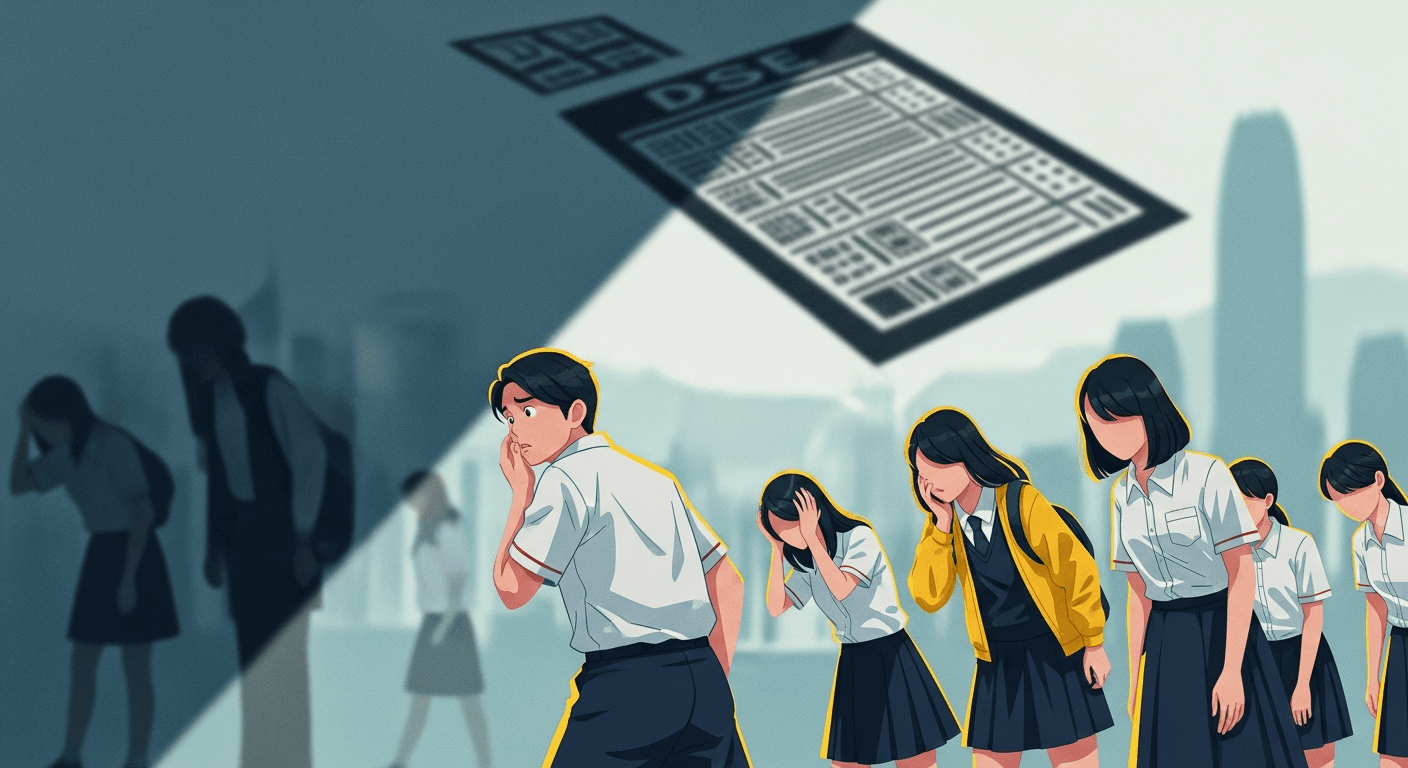
Secondary School Banding: The Hidden DSE Anxiety Cost of Early Competition
Do you remember the end of Primary Six? For many Hong Kong students, it wasn’t just about graduating. It was a period of intense pressure, hushed conversations about school choices, and the looming weight of the Secondary School Places Allocation (SSPA) system. It was the moment you, your friends, and your entire cohort were sorted, ranked, and labelled. You were assigned a "Band."
While that might feel like a lifetime ago as you tackle complex DSE syllabuses, the echo of that early competition can be surprisingly loud. The label—whether it was Band 1, 2, or 3—can create a hidden psychological cost that fuels DSE anxiety, shapes your self-belief, and impacts your study habits today. Let's unpack this hidden cost and explore how you can break free from it to unlock your true potential.
What Was the Banding System, Really? A Quick Refresher
Before we dive into the psychology, let's quickly recap. The SSPA system uses your internal school assessment results from Primary Five and Six to place you into one of three broad tiers, or "bands." This ranking determines your priority in choosing a secondary school. While the Education Bureau officially destigmatized the "banding" terminology, the underlying mechanism of sorting students based on academic performance remains.
The crucial thing to remember is this: the banding system is a logistical tool for school allocation, not a final verdict on your intelligence or future success. It’s a snapshot of your performance at age 11 or 12, influenced by countless factors like school scaling, subject weighting, and even how you were feeling on a particular test day. Yet, for many, this administrative label becomes a heavy piece of personal identity.
The Psychological Echo: How Banding Affects Your DSE Mindset
The real impact of the banding system isn't on a government spreadsheet; it's in your head. It can plant seeds of doubt or pressure that grow into significant challenges during your DSE preparation. Here’s how it often plays out:
The Self-Fulfilling Prophecy
If you were placed in a school perceived as "lower-band," you might have internalized the message that you're "not a top student." Teachers, peers, or even family might have unintentionally lowered their expectations. Over time, this can lead to a self-fulfilling prophecy where you start to believe the label and perform accordingly, limiting your own ambition for the DSE.
Imposter Syndrome in High-Achievers
Conversely, getting into a prestigious "Band 1" school comes with its own baggage. The pressure is immense. You might look at your brilliant classmates and feel like an imposter who just got lucky. Every less-than-perfect grade can trigger intense anxiety and the fear of being "found out." This constant need to prove you belong is a direct path to academic burnout, especially in the high-stakes DSE environment.
The "Fixed Mindset" Trap
Perhaps the most damaging legacy of banding is that it promotes a fixed mindset. It teaches you that academic ability is a static trait—you're either "smart" (Band 1) or you're not. This is fundamentally untrue. World-renowned psychologist Carol Dweck’s research shows that success comes from a growth mindset—the belief that intelligence and skills can be developed through dedication and hard work.
Example: A student with a fixed mindset hits a difficult DSE Maths problem and thinks, "See, I'm just not a maths person. My school band proved it." A student with a growth mindset thinks, "I don't understand this *yet*. What strategy can I try? Where can I find more practice questions on this topic?"
Breaking Free: Strategies to Overcome the Banding Mindset
Recognizing the problem is the first step. Taking back control of your narrative is the next. Your secondary school was a chapter, not your whole story. The DSE is your opportunity to write a new one. Here’s how.
1. Actively Cultivate a Growth Mindset
You need to consciously rewire your thinking. Every time you catch yourself thinking in fixed terms ("I'm terrible at Chinese writing"), reframe it. Acknowledge the challenge and focus on the process of improvement.
Pro Tip: Instead of aiming for a "Level 5**," set process-oriented goals like "I will complete and review three past papers for Chemistry this week" or "I will learn five new idioms for my Chinese essay." This shifts your focus from a fixed outcome to actionable, controllable steps.
2. Focus on Your Personal Progress, Not Labels
Your only competition should be the person you were yesterday. The Hong Kong education system can feel like a constant race, but for DSE, your goal is to achieve *your* personal best. Obsessing over what others are doing, their school's reputation, or past labels is a waste of precious mental energy.
Actionable Step: Keep a simple progress journal. At the end of each week, write down one concept you finally understood, one topic you feel more confident about, or one study habit you successfully implemented. This creates tangible proof of your growth, making external labels feel irrelevant.
3. Leverage Technology to Create Your Own Learning Path
One of the biggest limitations of the traditional school system—regardless of band—is its one-size-fits-all approach. Your teacher has to manage a class of 30+ students, making it impossible to cater to every individual's needs. This is where you can take charge.
Modern AI-powered learning tools are game-changers because they don't care about your school's name or your past performance. They assess what you know *right now*. A platform like Thinka's AI-Powered Practice Platform uses adaptive technology to deliver a truly personalized learning experience.
- If you're struggling with a concept in Biology, the AI will provide foundational questions to rebuild your understanding.
- If you're acing Electromagnetism in Physics, it will challenge you with more complex problems to deepen your mastery.
This approach breaks down the walls built by the banding system. It gives you a tailored pathway to improve, identifying your exact knowledge gaps and helping you fill them efficiently. It’s the ultimate tool for proving that your potential is not defined by your school's reputation, but by your own targeted effort.
The Bigger Picture: What Universities Actually Look For
When you fill out your JUPAS application, there isn't a box where your P6 school band is listed. Universities care about one primary thing: your HKDSE results. They look at your scores, your subject weightings, and your interview performance.
A student from any school who demonstrates mastery and passion for their chosen subjects is a more attractive candidate than a student from a "top" school with mediocre grades and a burnt-out attitude. Your final two years of focused exam preparation carry far more weight than a decision made when you were 12.
Furthermore, universities are increasingly looking for holistic candidates—students with critical thinking skills, creativity, and resilience. These are qualities you build through your DSE journey, not ones that are assigned to you by an allocation system.
Conclusion: You Are More Than Your Band
The pressure of the Hong Kong education system is undeniable, and the early competition from the SSPA can leave a lasting mark. It’s easy to let that old label define your limits and feed your anxiety as the DSE approaches.
But it is just that—a label. It is not your identity. Your intelligence is not fixed, your potential is not capped, and your future is not predetermined. By adopting a growth mindset, focusing on your unique progress, and using powerful tools to support your individual learning journey, you can overcome the hidden anxiety cost of the banding system.
You are in the driver's seat of your education now. Take control, believe in your capacity to grow, and focus on building the skills and knowledge you need to succeed. Start by exploring resources that empower you, like the comprehensive HKDSE Study Notes and adaptive exercises on Thinka, and prove that the only label that matters is the one you create for yourself: "successful."