
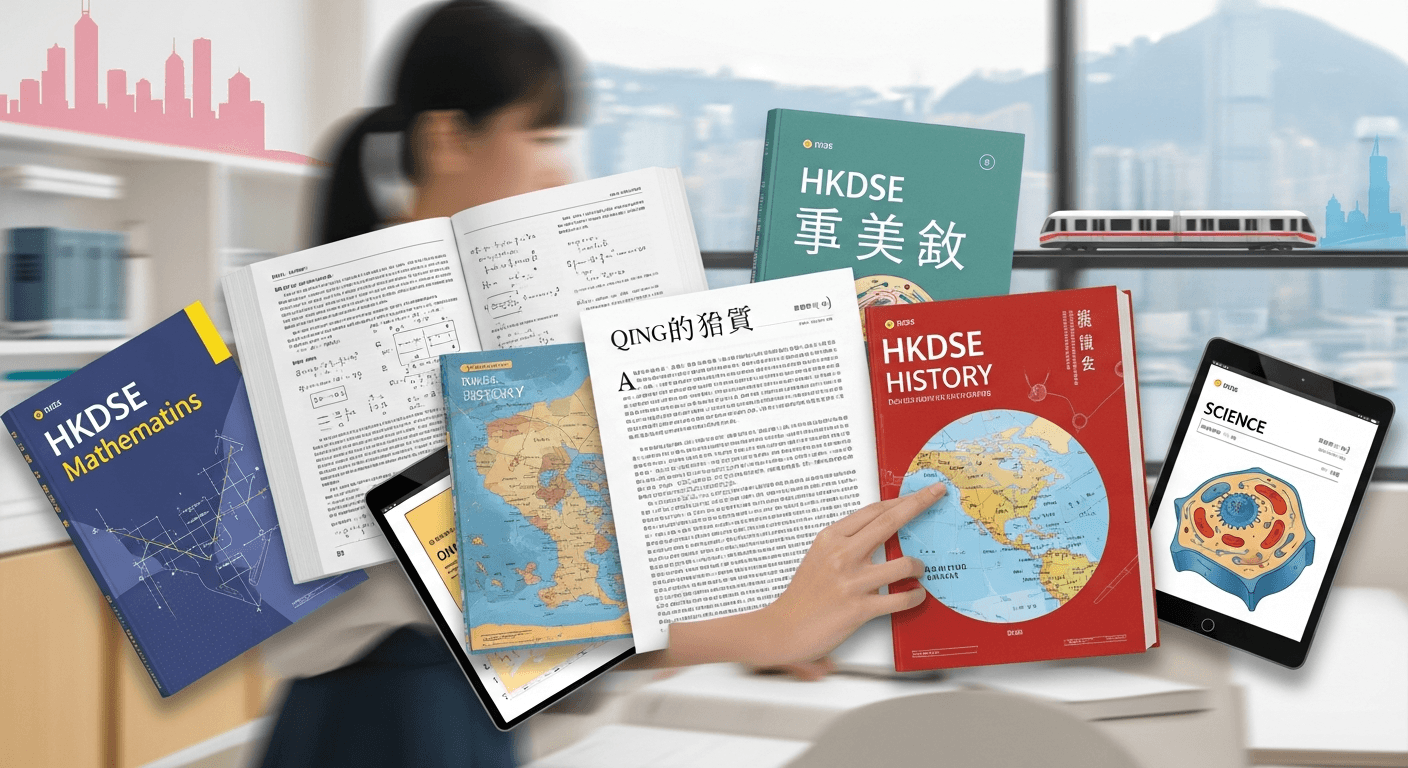
Beat Study Plateaus: Why Topic Switching is the HKDSE Mastery Hack
You’ve been staring at the same page of your DSE Chemistry textbook for an hour. The concepts of electrochemical cells are starting to blur into a meaningless soup of anodes, cathodes, and salt bridges. You feel like you’re hitting a wall – no matter how many times you re-read the chapter, nothing new is sticking. Your brain feels like a packed MTR train at rush hour: completely full and unable to take on any more passengers.
This is the dreaded study plateau, a phenomenon every HKDSE student knows all too well. It’s that frustrating point where hours of effort seem to yield zero results. The common advice? "Just push through it! Study harder!"
But what if the problem isn’t your effort, but your strategy? What if the key to breaking through this wall isn’t to push harder, but to pivot? Welcome to the world of topic switching – a scientifically-backed study hack that feels counterintuitive but is incredibly powerful for deep, long-term learning and HKDSE success.
What Exactly is Topic Switching (And Why Does It Feel So Weird?)
Topic switching, known in cognitive science as interleaving, is the practice of mixing up different topics or subjects within a single study session. This is the direct opposite of "blocking," the traditional method where you study one topic (e.g., Chapter 5 of your Maths textbook) for several hours until you feel you've "mastered" it.
Blocked Practice (The Old Way):
Maths Session: Problem A, Problem A, Problem A, Problem B, Problem B, Problem B…
Topic Switching (The Smart Way):
Maths Session: Problem A (Trigonometry), Problem B (Probability), Problem C (Circles), Problem A (Trigonometry), etc.
It feels weird because it’s harder. When you do blocked practice, you get into a rhythm. Your short-term performance feels great, and you gain a sense of confidence. However, this fluency is often an illusion. You’re mastering a short-term procedure, not building deep, flexible knowledge.
The Science Behind the Hack
Why is this struggle so beneficial? It comes down to two key principles:
- Forgetting and Retrieving: When you switch from Topic A to Topic B, your brain has to put away the information for Topic A. When you return to Topic A later, you force your brain to actively retrieve that information from your long-term memory. This process of forgetting and recalling strengthens the neural pathways, making the memory much more durable. It creates a "desirable difficulty" that cements learning.
- Enhanced Pattern Recognition: The HKDSE exam isn't a neat, chapter-by-chapter quiz. It’s a mix of problems from across the syllabus. By practicing with mixed topics, you train your brain to do the most critical first step of any exam question: identifying the problem type and selecting the correct strategy. You learn not just how to solve a problem, but which strategy to use and when.
Busting the "Blocking" Myth in the Hong Kong Education System
In the high-stakes environment of Hong Kong education, there's immense pressure to "master" every single topic. This often leads students to lock themselves away for a whole afternoon to conquer a single chapter, like the complex mechanics of heredity in DSE Biology or the nuances of the Cold War in DSE History.
The problem? This approach doesn't prepare you for the reality of the DSE.
Quick Fact: The Illusion of Fluency
Studies by cognitive psychologists like Robert Bjork have consistently shown that while students using blocked practice feel more confident and perform better during the study session itself, they perform significantly worse on the final test compared to students who used interleaving. The initial struggle of topic switching leads to superior long-term retention and application skills.
Think about a DSE Mathematics Paper 1. A question might look like a geometry problem on the surface but actually requires you to apply principles of algebra and trigonometry. A student who only practiced in blocks will struggle to make that connection. A student who used topic switching has already trained their brain to be flexible, see connections, and pull tools from different parts of their mental toolkit.
Your Action Plan: Implementing Topic Switching for HKDSE Exam Preparation
Ready to try it? Here’s a step-by-step guide to integrate this powerful technique into your study routine.
Step 1: The "Rule of Three"
Don't overwhelm yourself by switching between ten subjects. Start with three related, yet distinct, topics within one subject.
- For DSE Physics: Choose Mechanics, Waves, and Electricity.
- For DSE BAFS: Choose Financial Accounting, Cost Accounting, and Business Management.
- For DSE Liberal Studies (Citizenship and Social Development): Mix case studies from 'Hong Kong Under "One Country, Two Systems"' with concepts from 'Our Country Since Reform and Opening-Up'.
Step 2: Time-Box Your Focus
Use a timer to structure your session. The Pomodoro Technique is perfect for this.
- Study Topic A for 25 minutes.
- Take a 5-minute break.
- Switch to Topic B for 25 minutes.
- Take another 5-minute break.
- Switch to Topic C for 25 minutes.
- Take a longer break, and then repeat the cycle if you wish.
Step 3: Mix Your Practice Questions
This is where the magic happens. Don't just complete all the end-of-chapter questions in order. Instead, create mixed-topic practice sets. Do two questions from Chapter 3, two from Chapter 7, and two from Chapter 10. Shuffle them up.
Pro Tip: Let AI Be Your Personal Study Architect
Manually creating mixed-topic quizzes can be time-consuming. This is where AI-powered learning platforms are a game-changer. An advanced study platform like Thinka can revolutionize your HKDSE practice. Our AI doesn't just give you random questions; it analyzes your performance, identifies your weak spots, and generates personalized practice sessions that automatically interleave topics. It pushes you to retrieve information you're about to forget, making your study time incredibly efficient and building a truly robust understanding of the syllabus.
Overcoming the Initial Challenge: Trust the Process
Let's be honest: the first time you try topic switching, it will feel slow and frustrating. You'll feel like you're not making progress. This is normal. You are rewiring your brain to learn more deeply.
- Acknowledge the Difficulty: Remind yourself that the feeling of struggle is a sign of effective learning, not failure.
- Start Small: Begin with just two topics in a 60-minute session. As you get comfortable, you can expand to three or more.
- Focus on the Long Game: The goal isn't to feel like a genius during a 2-hour study block. The goal is to walk into the HKEAA examination hall with confidence, knowing your knowledge is solid, flexible, and ready to be applied to any question they throw at you.
Modern educational technology provides a safety net here. A personalized learning journey on a platform can adjust the difficulty and the mix of topics based on your real-time performance, ensuring you're always in the zone of "desirable difficulty" – challenged, but never completely overwhelmed.
Conclusion: Study Smarter, Not Just Harder
The path to HKDSE mastery isn't a straight line of brute-force memorization. It’s about building a dynamic, interconnected web of knowledge. Hitting a study plateau isn't a sign to double down on a failing strategy; it’s a signal to switch things up.
By breaking free from the illusion of blocked practice and embracing the powerful, science-backed method of topic switching, you train your brain for the real demands of the exam. You build deeper understanding, improve long-term recall, and develop the mental agility to see connections that others miss.
So, the next time you feel stuck, don't just push harder. Pivot. Switch topics. Challenge your brain in a new way. It might feel tougher in the moment, but your final HKDSE results will prove it was the smartest move you could make.
To begin building your topic-switching habit, browse our comprehensive HKDSE Study Notes to select your topics, and then put your knowledge to the ultimate test on our AI-Powered Practice Platform, where intelligent interleaving is built right into your learning journey.