
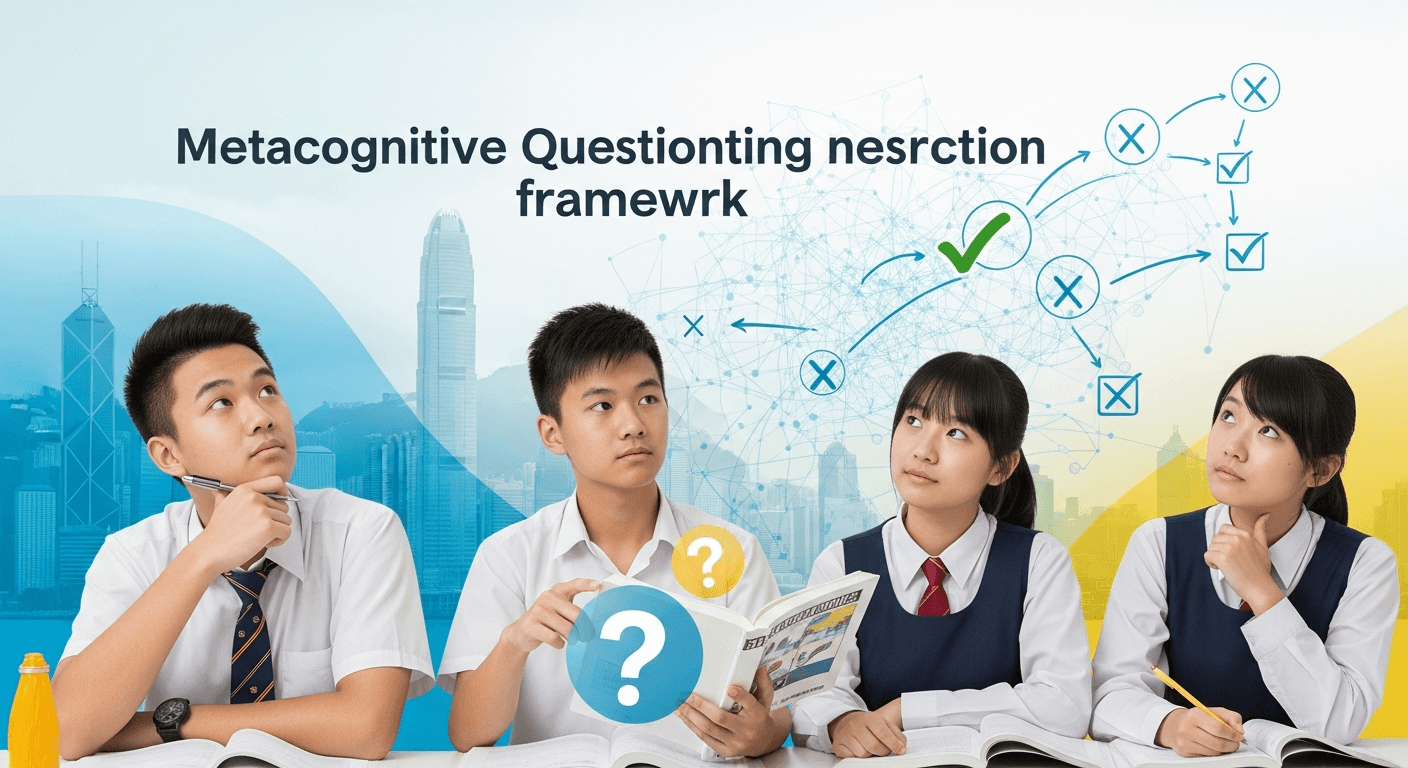
The "Phantom" Grade Drop: Why You Lose Marks You Deserve
Picture this scene: The exam timer stops. You put down your pen, feeling confident. You studied the topic, you knew the formulas, and the essay question looked familiar. But weeks later, when you get your mock paper back, your heart sinks. "Calculation error." "Misread the unit." "Answered the wrong part of the question." You didn't lose marks because you didn't know the material. You lost marks because of "careless mistakes." In the high-stakes environment of the HKDSE, where one mark can decide the difference between a Level 4 and a 5*, these errors are devastating. Most students try to fix this by doing more past papers. But doing more papers with the same "autopilot" brain leads to the same mistakes. To truly eliminate these errors, you need a different strategy. You need Metacognitive Questioning.What is Metacognition? (It’s Your Brain’s Manager)
In simple terms, metacognition is "thinking about your thinking." Imagine your brain has two modes during an exam.1. The Worker: Does the calculation, writes the sentence, retrieves the fact.
2. The Manager: Watches the Worker to ensure they are on task, efficient, and accurate. For many HKDSE students, the "Manager" is asleep during the exam. You are purely in "Worker" mode—rushing to finish, reacting to questions instinctively without checking if your approach is correct. Metacognitive questioning is the framework that wakes the Manager up. It involves asking yourself specific questions at three distinct stages of solving a problem to catch errors before they become permanent ink on your answer sheet.
The 3-Stage Self-Correction Framework
To implement this into your exam preparation, you need to break every complex question down into three phases.Phase 1: Pre-Action (The "Decoding" Phase)
Before you write a single number or word, stop. The biggest cause of "careless" errors is rushing into execution before understanding the requirements. Ask yourself these Metacognitive Questions:- "What are the specific command words here? (e.g., 'Compare' vs. 'Describe' in Biology, or 'Exact value' vs. '3 sig. fig.' in Math)"
- "Have I seen a question like this before where I fell into a trap?"
- "What information is given that I haven't used yet?"
The Trap: Assuming it's with replacement.
The Metacognitive Trigger: You ask, "Is the total number of items changing?" You re-read and see "without replacement." You just saved yourself 4 marks.
Phase 2: In-Action (The "Monitoring" Phase)
While you are in the middle of a long calculation or essay, it is easy to lose the plot. This is where you drift off-topic or carry forward a sign error. Ask yourself these Metacognitive Questions:- "Is this working step getting too complicated? Did I miss a simpler method?"
- "Am I still answering the specific question asked, or am I just dumping information I memorized?"
- "Did I copy the number from the line above correctly?"
The Metacognitive Trigger: Pause and check back to the question stem. "Does this paragraph support the 'Social' aspect?" If not, pivot immediately.
Phase 3: Post-Action (The "Audit" Phase)
This is not just "checking your work" (which usually just means reading what you wrote and nodding). This is a sanity check. Ask yourself these Metacognitive Questions:- "Does this answer make sense in the real world?"
- "If I plug this answer back into the equation, does it work?"
- "Did I include the units required?"
Your Answer: \( v = 3500 \text{ m/s} \).
The Metacognitive Trigger: "Is this realistic?" That is faster than the speed of sound. A car cannot drive that fast. You immediately know there is a unit conversion error or a decimal point mistake.
Why Traditional Practice Isn't Enough
Many students grind through HKDSE Study Notes and past papers, checking the marking scheme only after they finish the whole paper. The problem? The feedback loop is too slow. By the time you mark your paper, you have forgotten why you made the mistake. You just see "wrong" and think, "I'll be more careful next time." But "be careful" is not a strategy. This is where AI-powered learning changes the game.How AI Accelerates Metacognition
In a traditional classroom, a teacher might point out your thought-process errors once a week. With modern educational technology, you can externalize this "Manager" role until your brain learns to do it automatically. Platforms like Thinka are designed to provide personalized learning experiences that mimic this metacognitive process.1. Instant Feedback Loops
When you use a study platform like Thinka, you aren't just given a score. If you struggle with a step, the AI can guide you. This acts as an external monitor, prompting you to check your logic while the problem is fresh in your mind.2. Identifying Patterns
You might not realize that 80% of your errors in Math happen specifically when dealing with negative indices. You just think "Math is hard." An AI-powered system analyzes your performance data to highlight these specific weak points. It forces you to acknowledge the pattern, which is the first step in metacognition. Start Practicing in AI-Powered Practice Platform to turn these invisible blind spots into visible areas for improvement.Pro Tip: The "Error Analysis Log"
To bring this framework into your daily routine, stop treating your mistakes as failures. Treat them as data points. Create a specific notebook (or digital doc) for your Error Log. But don't just write down the correct answer. You must add a "Metacognitive Column."| Subject | The Mistake | The Metacognitive Fix (What question should I have asked?) |
|---|---|---|
| Math | Forgot \( \pm \) when square rooting \( x^2 = 16 \). | "Am I solving a quadratic? Does the variable represent a physical length (positive only) or a coordinate (can be negative)?" |
| English | Wrote a formal letter using slang/contractions. | "Who is the audience? Did I check the Tone/Register requirement in the Pre-Action phase?" |