
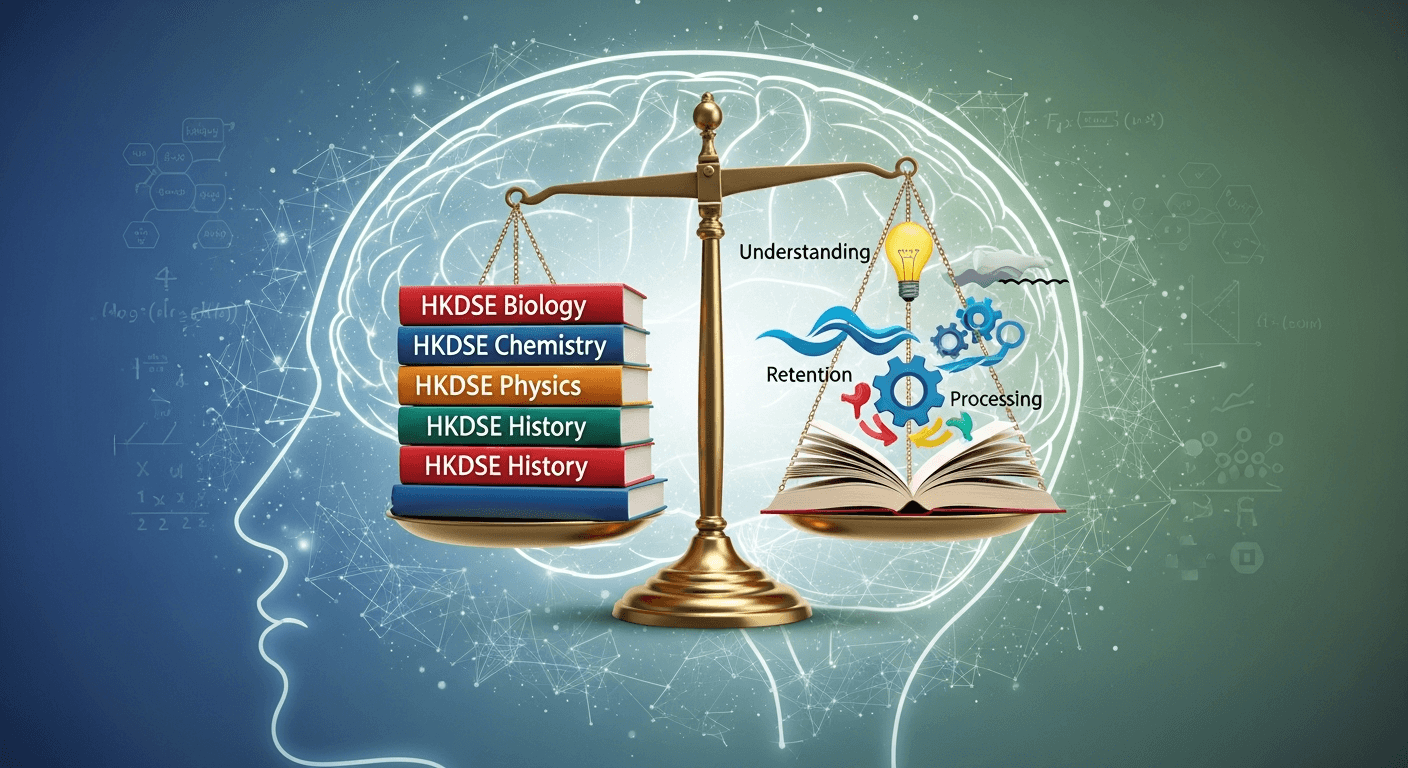
The Cognitive Load Equation: Balancing Mental Bandwidth for Superior Retention of Dense HKDSE Syllabi
Have you ever found yourself staring at a page of Biology notes for twenty minutes, only to realize you haven't absorbed a single word? You aren't tired, and you aren't distracted by your phone. You are experiencing "cognitive overload." For HKDSE students, the syllabus isn't just a list of topics; it is a dense forest of information. From the intricacies of **BAFS** accounting standards to the nuanced arguments required for **English Paper 2**, the sheer volume of data can crash your brain’s operating system. But here is the good news: Your brain isn't broken; its "bandwidth" is simply being mismanaged. In this guide, we will break down the science of **Cognitive Load Theory** and provide you with a mathematical approach to optimizing your study sessions. By balancing your mental equation, you can transform from a stressed student into a high-efficiency learning machine.The Science of "Brain Fog": Understanding Working Memory
To master the HKDSE, you first need to understand the hardware you are working with. Your brain has two primary types of memory relevant to studying: 1. Working Memory (RAM): This is limited. It can only hold about 3 to 5 "chunks" of new information at once. 2. Long-Term Memory (Hard Drive): This is effectively infinite. Learning happens when you successfully move information from your Working Memory to your Long-Term Memory. The bottleneck is always the Working Memory. If you flood it with too much data, too much noise, or disorganized concepts, the transfer fails. This is the **Cognitive Load**. We can express this as a formula: \[ \text{Total Cognitive Load} = \text{Intrinsic Load} + \text{Extraneous Load} + \text{Germane Load} \] To score that 5**, your goal is simple: Minimize the Extraneous, Manage the Intrinsic, and Maximize the Germane. Let’s break down how to solve this equation for your exam preparation.Variable 1: Minimizing Extraneous Load (The "Noise")
Extraneous Load is the mental effort wasted on things that don't help you learn. In the context of the HKDSE, this is usually poorly designed study material or disorganized instructions. If you are flipping back and forth between a textbook diagram on page 50 and the explanation on page 52, you are burning mental energy just to connect the dots. That is wasted bandwidth.Pro Tip: The Split-Attention Solution
Don't force your brain to hold an image in its RAM while searching for the text description.- Rewrite to Integrate: When making HKDSE Study Notes, place labels directly on diagrams (e.g., in Biology or Geography) rather than using a legend (A, B, C) on the side.
- Single Source Truth: Avoid having a textbook, a tuition note, and a Wikipedia page open simultaneously. This forces your brain to constantly "context switch." Consolidate your resources into one master document before you start memorizing.
Variable 2: Managing Intrinsic Load (The "Difficulty")
Intrinsic Load is the inherent difficulty of the subject matter. You cannot change the fact that M2 Calculus or the chemical reactions in DSE Chemistry are complex. That difficulty is "baked in." However, you can change how you interact with it. If you try to learn a complex concept all at once, your Working Memory overflows.Pro Tip: The Segmentation Strategy
If you are facing a complex 12-mark essay question in History or CSD: 1. Isolate the Elements: Don't try to write the whole essay. First, list the timeline. Then, list the key actors. Then, list the economic factors. 2. Master the Components: Ensure you understand each element individually before trying to link them. 3. Reassemble: Once the individual elements are in your Long-Term Memory (automated), your Working Memory is free to focus on the connections between them (the argument). Thinka’s Start Practicing in AI-Powered Practice Platform utilizes this effectively. By adapting the difficulty of questions based on your performance, it ensures the Intrinsic Load is never too high (causing anxiety) or too low (causing boredom). It keeps you in the "Goldilocks Zone" of learning.Variable 3: Maximizing Germane Load (The "Good Stuff")
Germane Load is the mental effort used to create "schemas"—mental blueprints that organize information. This is the good kind of effort. You want to use as much of your bandwidth here as possible. When you say, "Oh, this Physics formula is just like that concept in M1 Math," you are exerting Germane Load. You are building bridges.Pro Tip: Dual Coding
To maximize Germane Load, use two channels of your brain simultaneously: Visual and Verbal.For example, when revising for **DSE Economics**:
Don't just read the definition of "Market Equilibrium." Draw the Supply and Demand curve while saying the definition out loud. This "Dual Coding" allows you to process more information without overloading your working memory because the visual and verbal processors function somewhat independently.
The AI Advantage: An External "Cognitive Regulator"
In the past, students had to manage this equation manually. You had to decide what to study, find the materials, organize them, and test yourself. That management process itself creates high Extraneous Load! This is why **personalized learning** technology is a game-changer for the modern HKDSE student. 1. Adaptive Scaffolding: An AI tutor doesn't throw a Past Paper at you immediately. It assesses your level. If you are struggling with "Mole Calculations" in Chemistry, it breaks the problem down into smaller, manageable chunks (reducing Intrinsic Load) until you master the basics, then gradually increases the complexity. 2. Immediate Feedback Loop: Waiting weeks for a teacher to mark a paper creates a "disconnect" in your brain. When you finally get the paper back, you have to reload the context of the question (wasted bandwidth). AI provides instant feedback, meaning your brain is still in the "learning zone" when the correction arrives, maximizing retention. 3. Curated Focus: Instead of wondering "What should I study today?", AI algorithms analyze your weak points and serve up exactly what you need. This eliminates the "decision fatigue" (Extraneous Load) of planning a revision schedule.Quick Audit: Is Your Load Balanced?
Before your next study session, run this quick diagnostic: * Extraneous Check: Is my desk messy? Are my notifications on? Are my notes disorganized? (Goal: \( \downarrow \) Reduce) * Intrinsic Check: Am I trying to learn a huge topic (e.g., "The Cold War") all at once? Can I break it into "Causes," "Events," and "Consequences"? (Goal: \( \leftrightarrow \) Manage) * Germane Check: Am I just reading passively, or am I actively connecting this new topic to things I already know? (Goal: \( \uparrow \) Increase)Conclusion: Work Smarter, Not Just Harder
The HKDSE is a marathon, not a sprint. But more importantly, it is a test of efficiency. The students who score 5** aren't necessarily the ones who spent the most hours at their desks; they are the ones who managed their **Cognitive Load Equation** best. By reducing the noise, respecting the difficulty of the material, and utilizing modern tools to optimize your mental bandwidth, you can retain more information with less burnout. Whether you are in Junior Secondary School (S1 - S3) building your foundation, or in the final stretch of S6, protecting your mental bandwidth is your most valuable strategy. Don't let the syllabus crush your working memory. Take control of the equation.Ready to optimize your study routine? Let AI handle the heavy lifting of planning and difficulty management. Head over to the thinka Home Page and discover how our adaptive technology can help you study with maximum efficiency.