
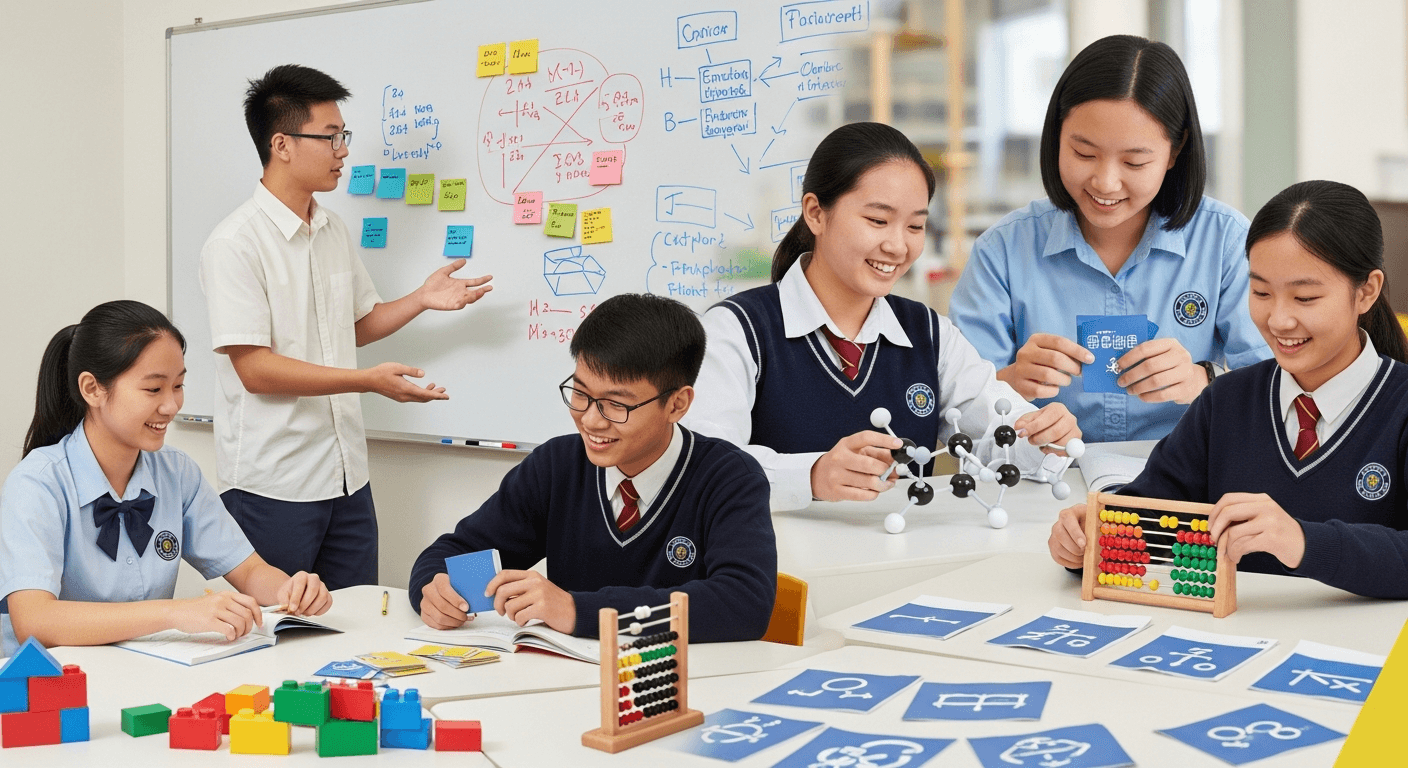
The Kinesthetic Advantage: Translating Primary Learning-Through-Play Strategies into High-Stakes DSE Revision
Picture the typical HKDSE revision scene: You are hunched over a desk in the self-study room, staring at a thick stack of BAFS notes or a Biology textbook for the third hour straight. Your back hurts, your eyes are glazing over, and despite your best efforts, the information just isn't sticking. You are suffering from "sedentary fatigue," a common enemy of the secondary school student.
Now, think back to primary school. You likely learned through blocks, games, role-play, and movement. While we often dismiss these methods as "child's play," modern educational neuroscience suggests that we abandoned them too soon. This is the Kinesthetic Advantage.
In this guide, we will explore how high-performing students can translate "Learning-Through-Play" strategies into rigorous, high-stakes exam preparation. We aren't suggesting you play tag; we are suggesting you hack your brain's motor cortex to secure that Level 5**.
Why "Sit Still and Listen" is Failing Your Revision
The traditional model of DSE prep relies heavily on visual (reading) and auditory (listening) learning. However, the human brain is evolutionarily designed to learn through interaction and movement. This is known as Embodied Cognition.
When you engage your body, you increase blood flow to the brain, specifically releasing a protein called BDNF (Brain-Derived Neurotrophic Factor), which acts like fertilizer for your neurons. By restricting yourself to a chair, you are literally cutting off the fuel supply your memory needs to encode complex syllabus points.
Quick Fact: Research indicates that students who stand or move while memorizing recall 20% more vocabulary than those who sit still.
Strategy 1: The "Walk-and-Talk" Protocol for Language Subjects
In primary school, students often sing songs or clap out syllables. For the HKDSE, we adapt this into the "Walk-and-Talk" protocol, particularly effective for English and Chinese Language subjects.
Many students struggle with the disconnect between their thoughts and their speech, leading to awkward pauses during SBAs or oral assessments. To bridge this gap:
- Pacing the Argument: When practicing for a persuasive speech or internalizing an essay structure, pace around your room. Assign a physical location in the room to a specific point in your argument. The window is your "Introduction," the door is your "Rebuttal." Walking between them creates a spatial map in your brain.
- Gestural Encoding: Don't just read vocabulary lists. If you are learning a complex adjective like "exacerbate," make a physical motion that represents it (e.g., widening your hands) while saying it aloud.
This technique leverages spatial memory, ensuring that when you sit down in the exam hall, your brain can "retrace" the steps to find the information.
Looking for structured content to practice this with? Check out our HKDSE Study Notes to find key vocabulary and arguments to set in motion.
Strategy 2: Gamifying the Grind with AI-Powered Learning
One of the core tenets of primary education is "gamification"—using rewards, levels, and immediate feedback to keep engagement high. As we get older, we lose this feedback loop. We do a past paper, wait a week for a teacher to mark it, and by then, we've forgotten the mistake. This delay kills motivation.
This is where AI-powered learning acts as the modern, mature version of "play." Platforms like Thinka bring the engagement of gaming into serious study.
The "Flow State" Loop
In gaming, you enter a "flow state" when the challenge perfectly matches your skill level. If it's too hard, you quit; too easy, you get bored. Traditional revision is rarely optimized for this. You might be struggling with a math concept while the textbook assumes you already know it.
Thinka’s personalized learning algorithms solve this by:
- Adaptive Difficulty: The AI analyzes your performance in real-time. If you crush a set of Chemistry MCQs, it instantly scales up the complexity. If you stumble, it dials back to reinforce the foundation.
- Instant Feedback: Just like getting points in a video game, getting immediate corrections on your answers releases dopamine, encouraging you to do "just one more question."
By treating your revision sessions like a leveled game, you reduce exam anxiety and increase study duration without feeling the burnout.
Ready to turn your revision into an interactive challenge? Start Practicing in AI-Powered Practice Platform and experience the difference adaptive technology makes.
Strategy 3: Tactile Mapping for STEM Concepts
Primary students use blocks to learn counting. DSE students often try to learn 3D concepts from 2D textbook pages, which is inefficient for subjects like Mathematics (Geometry), Physics, and Chemistry.
The Strategy: Bring the abstract into the physical world.
Physics & Math: The Physical Variable
When studying Mechanics or 3D Trigonometry, stop staring at the diagram. Use a pen, a ruler, and an eraser to build the model on your desk. Manipulate the objects to see how the angle \( \theta \) changes the projection.
For example, when visualizing the cross-product in vectors or the Right-Hand Grip Rule in Electromagnetism, physically performing the hand motions is non-negotiable. It encodes the rule into your muscle memory, so you don't blank out under pressure.
If you are struggling with complex equations like the Normal Distribution formula:
$$ f(x) = \frac{1}{\sigma\sqrt{2\pi}} e^{-\frac{1}{2}(\frac{x-\mu}{\sigma})^2} $$
Don't just write it. "Build" it. Use sticky notes on a wall to arrange the variables. Physically moving the \( \sigma \) (standard deviation) to see where it fits helps break down the visual complexity of the formula.
Strategy 4: The "Feynman Role-Play"
Children love to play "teacher." It turns out, this is the highest form of learning. The Feynman Technique involves explaining a concept simply, as if teaching a beginner. But we can take it a step further: Simulated Teaching.
Instead of just reciting notes, stand up and deliver a lecture to an empty chair (or your pet). Use a whiteboard or tape paper to your wall. Draw diagrams actively while you speak.
Pro Tip: Record your "lecture" on your phone. Listening to your own voice explaining the concept of "Osmosis" or "Opportunity Cost" is often more effective than listening to a stranger, because you recall the physical act of explaining it.
This method exposes "illusion of competence." If you stumble while explaining a concept out loud, you don't know it well enough. This is a key aspect of Junior Secondary School (S1 - S3) Study Notes mastery that should be carried forward into the DSE.
Strategy 5: Interactive Error Analysis
In primary school, if you knock over a tower of blocks, you immediately see why it fell (gravity, poor base). in DSE revision, students often ignore their mistakes. They check the marking scheme, say "oops," and move on.
To apply a kinesthetic approach to error analysis, you need to "debug" your process actively.
Using a study platform like Thinka allows for a digital version of this. When you get a question wrong, the AI helps you dissect the step where the logic failed, not just the final answer. This is "active correction." Instead of passively reading the right answer, you are guided to re-derive it.
Integrating Kinesthetic Revision into Your Schedule
You cannot run around for 8 hours a day. The key is to mix these high-energy strategies with deep work.
Sample Schedule Block (The 60-Minute Split):
- 0-25 mins (Deep Work): Sit down. Complete a focused set of questions on Thinka or a past paper. No distractions.
- 25-30 mins (Kinesthetic Break): Stand up. Walk around. Recite the key formulas or definitions you just used. Stretch to reset the spine.
- 30-50 mins (Tactile Review): Use flashcards, draw mind maps on a large sheet of paper, or "teach" the concept to the wall.
- 50-60 mins (Rest): True rest. Eyes off screens.
Conclusion: Move to Master
The transition from Primary to Secondary education often strips away the joy and movement of learning, replacing it with rigid, sedentary memorization. But the HKDSE is not just a test of what you can read; it is a test of what you can retrieve and apply under pressure.
By re-integrating kinesthetic strategies—movement, tactile mapping, role-play, and AI-driven gamification—you are not regressing; you are evolving your study habits to match how your brain actually works. You are turning passive revision into active training.
Don't let your DSE journey be static. Get up, get moving, and let technology guide your path to success.
Ready to modernize your revision? Visit the Thinka Home Page to see how our AI solutions can bring your study sessions to life.