
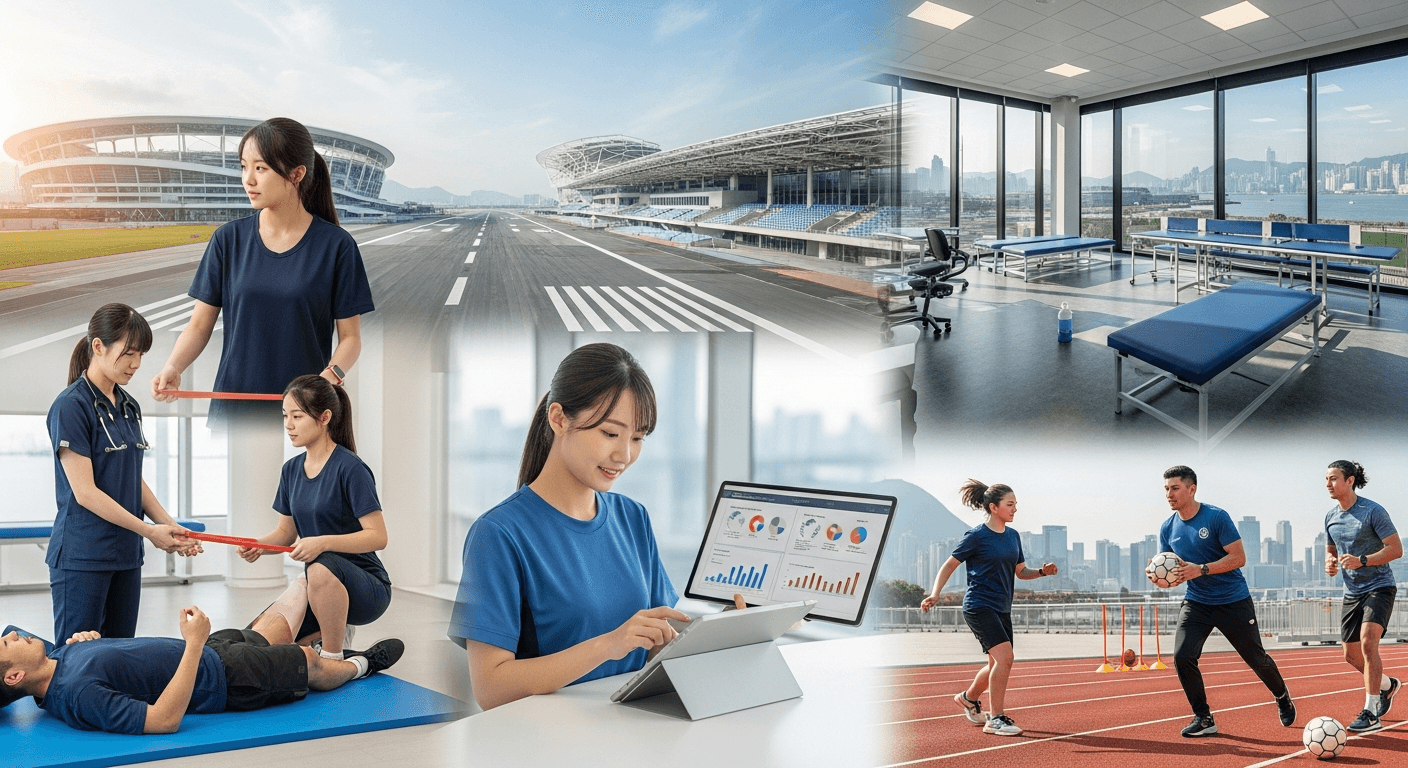
The Kai Tak Catalyst: Launching Emerging Post-DSE Roles in Sports Management and Rehabilitation Therapy
For decades, the standard advice for Hong Kong students has been to aim for Medicine, Law, or Finance. But look towards the Kowloon skyline, and you will see a massive shift in the landscape—literally. The impending full opening of the Kai Tak Sports Park (KTSP) is not just about a new stadium; it represents a fundamental shift in Hong Kong’s economy and, consequently, its career opportunities.
With a 50,000-seat main stadium, indoor sports centers, and vast public spaces, KTSP is set to become a hub for international events, from the National Games to global concert tours. For HKDSE students, this infrastructure boom signals the rise of two distinct, high-potential career tracks: Sports Management and Rehabilitation Therapy.
If you have a passion for sports but know your future isn't necessarily on the field as a professional athlete, this is your "catalyst" moment. Let’s explore how current DSE students can align their electives and study strategies to capitalize on this emerging wave.
The "Hardware" Track: Sports and Recreation Management
The misconception is that working in sports management means being a P.E. teacher. While teaching is a noble path, the industry has expanded significantly. The "Mega-Event Economy" promoted by the Hong Kong government requires a legion of professionals who understand business, logistics, and sports culture.
What Does This Career Look Like?
Modern sports management involves the strategic planning behind the scenes. Roles include:
- Event Operations Manager: Coordinating logistics for events like the Rugby Sevens or international marathons.
- Sports Marketing Specialist: Managing sponsorships and brand partnerships for athletes and teams.
- Facility Management: Overseeing the complex operations of venues like Kai Tak or local clubhouses.
The JUPAS Connection
Universities like CUHK, HKBU, and PolyU offer dedicated degrees in Sports and Recreation Management. However, admission isn't just about athletic ability. These are academic degrees that require strong analytical skills.
Pro Tip: High grades in BAFS (Business, Accounting, and Financial Studies) and English Language are crucial. The industry is global; being able to negotiate contracts in English or analyze the financial viability of a tournament is key. If you are taking BAFS, focus on the management modules—understanding organizational structure is directly applicable here.
The "Software" Track: Rehabilitation and Sports Science
While management handles the venues, the "software" of the industry involves the human body. With an aging population in Hong Kong and a surge in amateur running and gym culture, the demand for Rehabilitation Therapy and Physiotherapy has skyrocketed. The Kai Tak Catalyst will further drive demand for high-performance support for visiting teams and local elite athletes.
Distinguishing the Roles
It is vital for HKDSE students to understand the difference between the disciplines before choosing JUPAS choices:
- Physiotherapy (PT): A medical profession focused on restoring movement and function to people affected by injury, illness, or disability. This is highly competitive in JUPAS.
- Occupational Therapy (OT): Focuses on enabling people to participate in everyday life activities, often after recovery.
- Sports Science: Focuses on maximizing performance through biomechanics, physiology, and psychology.
The DSE Academic Hurdle
Admissions for PT and OT programs (primarily at PolyU and TWC) are notoriously competitive. You are essentially competing with medical school applicants.
Required Electives: You must excel in Biology and/or Physics.
In Physics, understanding mechanics is essential for biomechanics. For example, calculating torque \(\tau\) regarding joint movement:
$$ \tau = r \times F \sin(\theta) $$
Universities look for students who can apply these scientific principles to the human body.
Quick Fact: The weighting for Science subjects in these JUPAS programs is often heavy (e.g., x1.5 or x2). A Level 5 in Biology is often worth more than a Level 5** in a non-weighted elective for these specific major calculations.
Optimizing Your Study Strategy with AI
Whether you are aiming for the management track (Arts/Business heavy) or the therapy track (Science heavy), the competition is fierce. The traditional method of rote memorization is often too slow to cover the vast HKDSE syllabus effectively. This is where AI-powered learning becomes your secret weapon.
1. Mastering Biology Keywords for Rehab Tracks
In DSE Biology, understanding the concept is only half the battle; writing the exact keywords required by the HKEAA marking scheme is the other half.
The Problem: Students often write long paragraphs explaining a physiological process but score zero because they missed specific terms like "vasodilation" or "negative feedback."
The AI Solution: Platforms like Start Practicing in AI-Powered Practice Platform utilize adaptive technology to analyze your answers. Instead of just telling you you're wrong, an AI tutor can pinpoint exactly which keywords were missing from your explanation of the skeletal-muscular system, helping you close the gap between "understanding" and "scoring."
2. Case Analysis for Management Tracks
For BAFS and Economics, you are often required to apply theories to case studies.
The Problem: Textbooks have limited examples. Once you've done the past papers, you run out of practice material.
The AI Solution: Advanced educational tools can generate infinite variations of business scenarios. You can practice applying SWOT analysis or marketing mix strategies to new, unique contexts generated by AI, ensuring you aren't just memorizing past answers but truly learning the logic.
Practical Steps for S4-S5 Students
If the opening of Kai Tak Sports Park inspires you, here is your roadmap for the next two years:
Step 1: Check the Weighting
Visit the JUPAS websites for HKU, CUHK, PolyU, and others. Look specifically at "Sports Science" and "Physiotherapy." Note which subjects are heavily weighted. If Biology is your ticket in, you need to prioritize it in your revision schedule immediately.
Step 2: Build Your Portfolio (OLE)
For Sports Management, leadership matters. Organizing a house event, an inter-school friendly, or volunteering at a local charity run counts. For Therapy, try to get First Aid certification (St. John Ambulance or Red Cross). It shows admissions officers you are serious about the clinical side of care.
Step 3: Efficient Exam Preparation
Don't burn out by studying harder; study smarter. Use personalized learning tools to identify your weak points. If your Physics mechanics are strong but your wave motion is weak, use an intelligent study platform to serve you questions specifically targeting that weakness.
You can find comprehensive resources to help structure your revision here: HKDSE Study Notes.
Conclusion: Your Warm-Up Starts Now
The Kai Tak Sports Park is more than concrete and steel; it is a symbol of Hong Kong's evolving industry landscape. The jobs of tomorrow in Sports Management and Rehabilitation Therapy offer exciting, dynamic environments that desk jobs cannot match. However, the entry ticket to these careers is a solid performance in the HKDSE.
Whether you are calculating forces in Physics for a future in Physiotherapy or analyzing market trends in BAFS for a future in Sports Marketing, the preparation requires discipline. Embrace modern tools, leverage AI-powered practice, and treat your DSE preparation like an elite athlete treats their training: with precision, consistency, and a focus on continuous improvement.
The stadium opens soon. Will you be ready to join the team?
Ready to train your brain for the DSE? thinka Home Page offers the intelligent support you need to excel.